Posts

Showing posts with the label design

The big one: Getting to orbit
Image
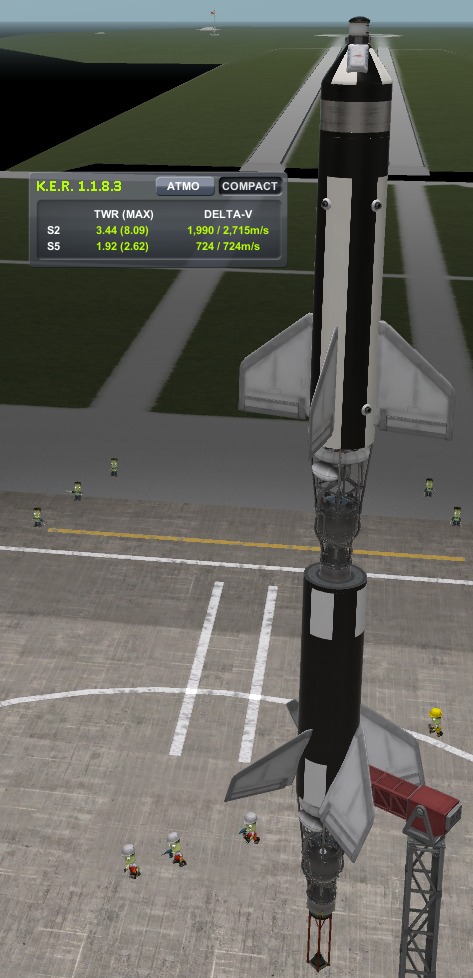
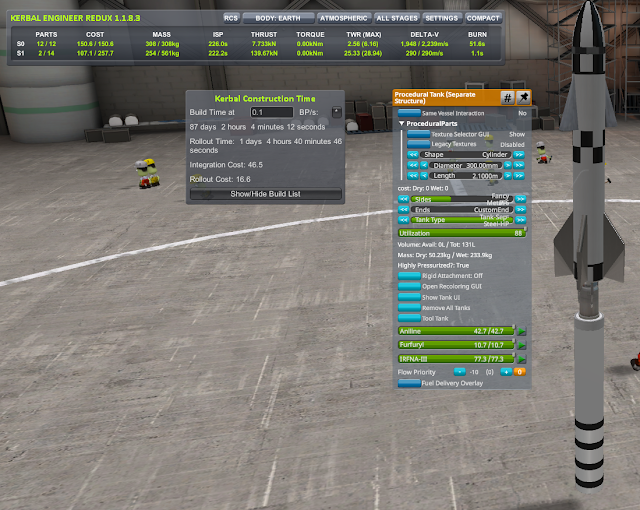
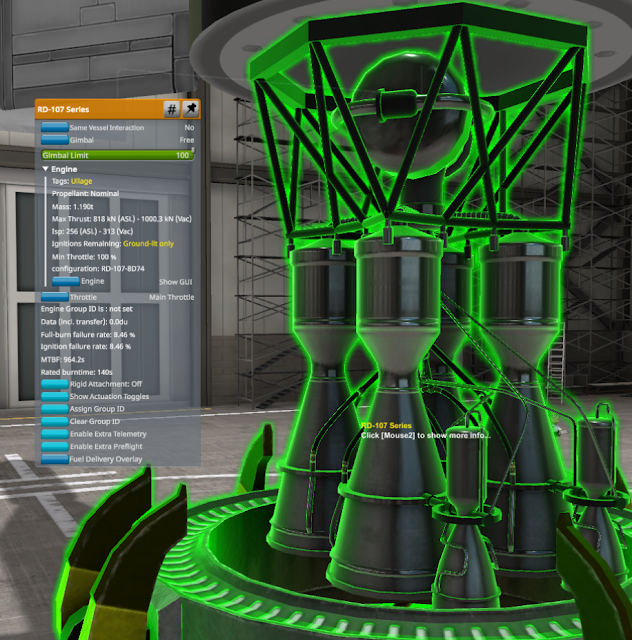
The time has come to build our first orbit-capable rocket and design a payload for it. Woden Main Stage At the core of our new design is a new engine, similar to the RD-107 rocket engine used as the main engine on the Soviet's R-7 rocket . It can achieve a specific impulse (ISP, which roughly equates to efficiency) of 255 in atmosphere and offers a whopping 820 kN of thrust, far in excess of anything our space program has worked with before. Despite this, it's conceptually pretty similar to the V-2 rocket engine, only swapping out the ethanol for the more efficient kerosene . Woden Engines We are currently constructing a new launch pad capable of shifting 60 tonnes (three times our previous mass). Easily growing to match our new facilities, our new rocket core weighs a whopping 58 tonnes by itself. We have full avionic control and can control it using the built-in vernier engines . This design is intended to be modular, growing to meet the needs of our orbital programme mov...

Confidence is high. I repeat, confidence is high.

Image
Date : 1954-06-13 Amidst news that the Soviets may be developing an Intercontinental Ballistic Missile (ICBM), their so-called "R7" project , we have been tasked with producing a rocket capable of reaching from Western Europe to Moscow. The objective is simple in its audacity: Increase our rocket's capabilities from 600km downrange to over 3,000km, creating an Intermediate-Range Ballistic Missile (IRBM) before the two superpowers. We have a range of new technological innovations on our side: We have developed a newer, lighter, aluminium alloy for our rockets. We have improved our existing main rocket engines (on par with the Russian RD-102). We have improved our avionics to the point we can control our rocket launches. We have also developed a new upper stage rocket engine similar to the US AJ10-27 engines, which use nitric acid/aniline and are the latest generation of the SR-1 engines we flew right back in 1951. Historical Aside: The Russian RD-102 was never actually d...

Designing a basic rocket plane, the Y-1

Image
Rocket science is fundamentally pretty simple. Big explosion go down, steel cylinder go up. A very simple implementation of Newton's third law : "For every action, there is an equal and opposite reaction ". Building aeroplanes is somewhat trickier. In ordinary (stock) Kerbal, building your first aeroplane is generally tougher than building, say, an orbital rocket, but the aerodynamic model is still pretty simple and forgiving. Something that is sort of like a plane will still fly. RP-1, specifically the mod FAR , is not nearly so forgiving. First, let's make it clear that we're not building a traditional plane. While RP-1 does let you build propeller planes of the era, I've decided to head straight to rocket-planes . Rocket planes are what they sound like, planes that are primarily (or solely) powered by rocket engines. Historically, the most famous rocket plane is the Bell X-1 , the spiritual analogue of the Y-1 we're about to build. In our fantasy timel...

Iterative improvement

Image
Proudly presenting the SR-2c This design is quite different from SR-2b. Instead of relying on two large RD-101 engine stages, the second stage is now powered by an engine that's part-way between the SR-1 and SR-2 engines offering 28.8kN of thrust in atmosphere. Historical aside: In fact, the engine is based off an engine designed for use by rocket planes: The XLR11 used by the X-Plane project. We're re-purposing it here, but we'll probably also stick it to our plane as our new project after the SR-2. The overall rocket has a significantly higher delta-v than the SR-2, easily capable of achieving 40% of that needed to get in to Earth orbit in fact! Delta-V is the 'main currency' of space flight and reflects a rocket's total change in velocity over time, a reflection of its overall capability. Our long-term goal is to get our delta-v up to 10,000dV, at which point we should be able to achieve a Low Earth Orbit of 2,000km. I have also added launch towers to en...

Not every rocket's a winner

Image
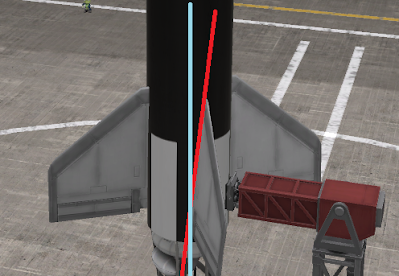
My initial concept for the SR-2b was to adding staging to the rocket design to be able to get more distance out of it and perform sub-orbital re-entry tests: This design certainly fit the bill in some respects. On a good day it could achieve a height of 250km, double what we'd managed previously. Having similar fuel tanks and engines reduces the tooling cost significantly. It also had no issues around recovery of the payload vehicle (a biological sample)... when it worked. Despite these plus points, I ran in to a major issue with the design. Notice how severely tilted the wing fins are; this was the level of spin stabilisation required to achieve the needed level of spin to keep it going straight. Precession is a natural consequence that comes with spin stabilisation . If the spinning of the rocket is too strong, a large degree of precession occurs. Precession is best demonstrated with a spinning-top example: Source: http://hyperphysics.phy-astr.gsu.edu/hbase/top.html As our leve...

You spin me right round, baby, right round, like a rocket baby

Image
Project : SR-2 Sounding Rocket Purpose : Demonstrate the ability to carry non-trivial payloads out of Earth atmosphere on sub-orbital missions The most critical component of our SR-2 rocket which will distinguish it from the SR-1 is the much more powerful engine. The engine we're using for this rocket is equivalent to the RD-101, a derivative of the German V-2 rocket engine, capable of ~400Kn of thrust on launch as opposed to the ~7kN of the SR-1. No that is not a typo. Historical Note: Both the USA and the USSR cloned and then improved upon the V-2 rocket engine design. The RD-101 was completed by the Soviet Glushko Bureau ( OKG-456) with no German engineers involved, but based heavily on the V-2 design. The RD-101 would go on to be used in the R-2 short range ballistic missile (NATO Name: SS-2 Sibling). The R-2 rocket was originally considered for the first Russian manned sub-orbital flights, but this was skipped in favour of going straight in to orbit in the flight ultimately...

Our first, less than modest, Sounding Rocket

Image
Our story begins on January 1st, 1951 . We've been tasked with creating a fledgling space rocket program by the newly formed Council of Europe . The USA and USSR have managed to 'poach' many of the top German scientists and already have established own space programs (though NASA is a way off existing yet). We, on the other hand, have been dumped in the desert of Africa with a seemingly endless supply of exotic fuels and an ahead-of-its-time ability to simulate rocket flights. We start with 50,000 funds and a dream. Our first strategic objective from the European Commission for Really Cool Space Flights is to get off the ground, but I have much larger ambitions than that (which will no doubt be the death of me or, at least, some of our crews). Sounding Rockets are research rockets, designed to take measurements on the nature of rocketry and space itself. Their research is intended to be used to 'sound out' the feasibility of space travel. In RP-1, we'll start...