Posts

Showing posts with the label rocket

The big one: Getting to orbit
Image
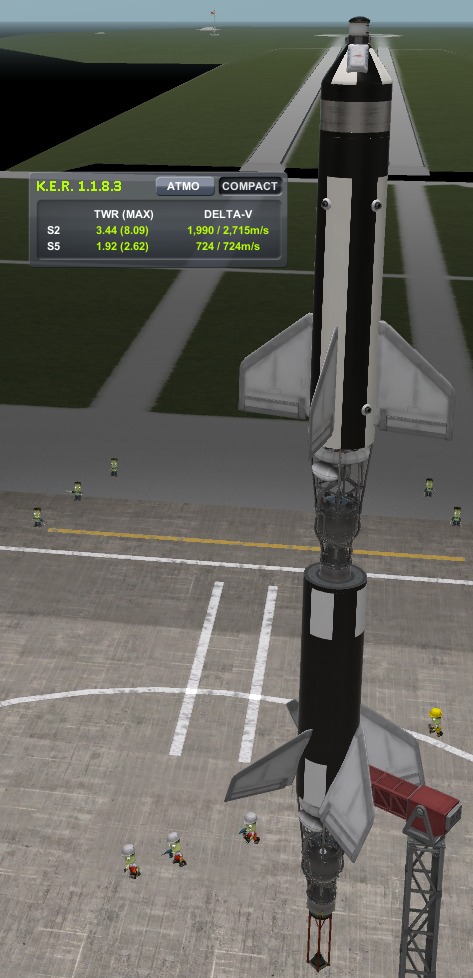
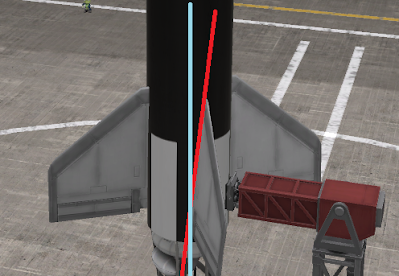
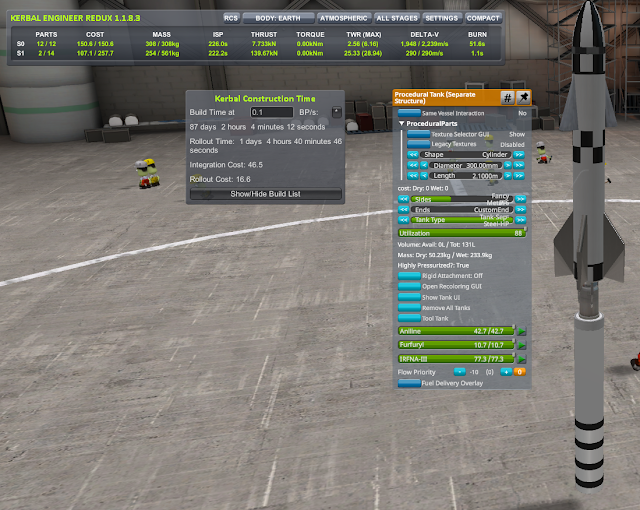
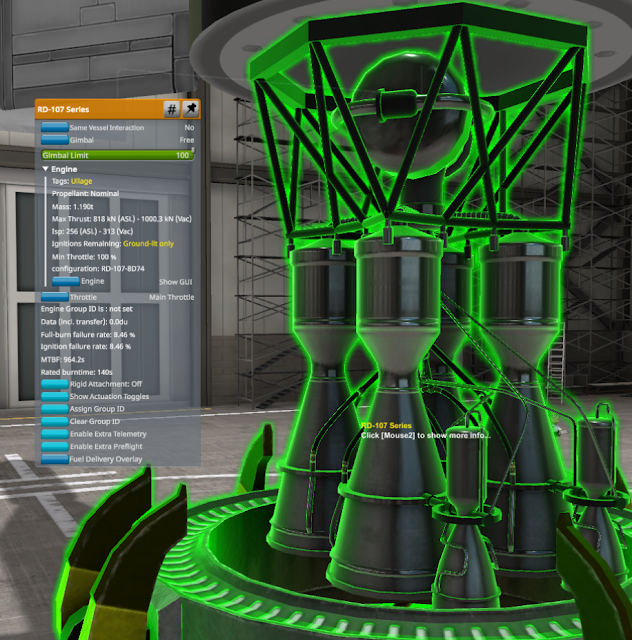
The time has come to build our first orbit-capable rocket and design a payload for it. Woden Main Stage At the core of our new design is a new engine, similar to the RD-107 rocket engine used as the main engine on the Soviet's R-7 rocket . It can achieve a specific impulse (ISP, which roughly equates to efficiency) of 255 in atmosphere and offers a whopping 820 kN of thrust, far in excess of anything our space program has worked with before. Despite this, it's conceptually pretty similar to the V-2 rocket engine, only swapping out the ethanol for the more efficient kerosene . Woden Engines We are currently constructing a new launch pad capable of shifting 60 tonnes (three times our previous mass). Easily growing to match our new facilities, our new rocket core weighs a whopping 58 tonnes by itself. We have full avionic control and can control it using the built-in vernier engines . This design is intended to be modular, growing to meet the needs of our orbital programme mov...

Dogs (and cat) of space

Image
Routine Mission (1955-01-25): A simple SR-2a sounding mission that succeeded with no complications. Routine Mission (1955-06-25): This mission necessitated a modified version of the SR-2d with the second stage engines and fuel removed and the first stage power reduced somewhat. This made the rocket slow enough to be capable of re-entry, allowing for the returning a biological experiment. It was a successful mission.   Routine mission (1955-11-23): For this mission we were tasked with taking up an ' advanced biological payload' in a sub-orbital trajectory and returning it. The modified re-entry capable SR-2d was selected for the job. Buddy the dog has successfully returned to Earth safely without any issues and earned his wings! Historical Aside: The first dogs in to space were strays called Tsygan and Dezik, sent up as early as 1951 on R-1 rockets . Dezik perished on a second flight after the parachute on their capsule failed. Tsygan survived the programme and would be adopte...

Onwards and sidewards [Video]

Image
Reminder: Our mission objective is fly a sub-orbital trajectory travelling over 3000km across Africa, putting us in Egypt (or thereabouts). Our payload is not expected to survive re-entry in to the atmosphere. Just a video this time, I don't want to spoil anything: Next Post: Dogs (and cat) of space

Confidence is high. I repeat, confidence is high.

Image
Date : 1954-06-13 Amidst news that the Soviets may be developing an Intercontinental Ballistic Missile (ICBM), their so-called "R7" project , we have been tasked with producing a rocket capable of reaching from Western Europe to Moscow. The objective is simple in its audacity: Increase our rocket's capabilities from 600km downrange to over 3,000km, creating an Intermediate-Range Ballistic Missile (IRBM) before the two superpowers. We have a range of new technological innovations on our side: We have developed a newer, lighter, aluminium alloy for our rockets. We have improved our existing main rocket engines (on par with the Russian RD-102). We have improved our avionics to the point we can control our rocket launches. We have also developed a new upper stage rocket engine similar to the US AJ10-27 engines, which use nitric acid/aniline and are the latest generation of the SR-1 engines we flew right back in 1951. Historical Aside: The Russian RD-102 was never actually d...

Scaring Moroccans

Image
Routine Mission (1953-02-27): Sent up an SR-2c payload to complete a biological capsule contract. Went smoothly without issues, netting a big ol' payment which was immediately funneled to R&D. To complete our next mission from the French Ministère des Armées , to take an early film camera and photograph a stretch of North Africa from a height of at least 100km while travelling over 200km, will require a variation of our SR-2 design: This monster of a single engine-staged rocket is capable of taking the 160kg payload over 200km high and nearly 650km downrange, all the way to the west coast of Africa, where parachutes can bring the film down safely for study. The mission was completed successfully on 1953-06-04. We now have 40k in funds and 39 (!) in unspent Science™. 20k of those funds are going to be push straight in to ongoing R&D, which continues to be our main priority. The sooner we can unlock new materials technology, the sooner we can make the leap to more powerful en...

There and back again, a fruit fly's tale [Video]

Image
I noticed in the final simulation that sometimes the design re-enters on the opposite end of the payload than I'd planned. Rather than adding more ablative steel I had a bit of a rummage through the other equipment we already have. I decided to re-purpose a thrust plate. Thrust plates are designed for separating fuel tanks from rocket engine(s) and allowing the mounting of multiple engines. Since they sit directly above rocket engines, they are rated for around 2000K instead of the 700K of steel, making them effective as heat shields for our purposes. As you can see, the flight went well:  aaaand touchdown: Our payload returned successfully and we're now drowning in Science™! We also have enough money to fund the Y-Plane project, finally coming up next...

Iterative improvement

Image
Proudly presenting the SR-2c This design is quite different from SR-2b. Instead of relying on two large RD-101 engine stages, the second stage is now powered by an engine that's part-way between the SR-1 and SR-2 engines offering 28.8kN of thrust in atmosphere. Historical aside: In fact, the engine is based off an engine designed for use by rocket planes: The XLR11 used by the X-Plane project. We're re-purposing it here, but we'll probably also stick it to our plane as our new project after the SR-2. The overall rocket has a significantly higher delta-v than the SR-2, easily capable of achieving 40% of that needed to get in to Earth orbit in fact! Delta-V is the 'main currency' of space flight and reflects a rocket's total change in velocity over time, a reflection of its overall capability. Our long-term goal is to get our delta-v up to 10,000dV, at which point we should be able to achieve a Low Earth Orbit of 2,000km. I have also added launch towers to en...

Not every rocket's a winner

Image
My initial concept for the SR-2b was to adding staging to the rocket design to be able to get more distance out of it and perform sub-orbital re-entry tests: This design certainly fit the bill in some respects. On a good day it could achieve a height of 250km, double what we'd managed previously. Having similar fuel tanks and engines reduces the tooling cost significantly. It also had no issues around recovery of the payload vehicle (a biological sample)... when it worked. Despite these plus points, I ran in to a major issue with the design. Notice how severely tilted the wing fins are; this was the level of spin stabilisation required to achieve the needed level of spin to keep it going straight. Precession is a natural consequence that comes with spin stabilisation . If the spinning of the rocket is too strong, a large degree of precession occurs. Precession is best demonstrated with a spinning-top example: Source: http://hyperphysics.phy-astr.gsu.edu/hbase/top.html As our leve...

Sounding Rocket 2, now with 200% more sounding [Video]

Image
Here's the SR-2 first flight video (raw unedited): No problems! Nice, easy flight, sneaking our payload up to a comfortable 140km. Still, this is quite modest given the capabilities of our rocket. We'll want to take the core concept and develop it at a bit to push the envelope and score some more contracts. In the next post we'll look at developing the SR-2b, a multi-stage variant of the SR-2 taking advantage of our rocket's untapped power.

You spin me right round, baby, right round, like a rocket baby

Image
Project : SR-2 Sounding Rocket Purpose : Demonstrate the ability to carry non-trivial payloads out of Earth atmosphere on sub-orbital missions The most critical component of our SR-2 rocket which will distinguish it from the SR-1 is the much more powerful engine. The engine we're using for this rocket is equivalent to the RD-101, a derivative of the German V-2 rocket engine, capable of ~400Kn of thrust on launch as opposed to the ~7kN of the SR-1. No that is not a typo. Historical Note: Both the USA and the USSR cloned and then improved upon the V-2 rocket engine design. The RD-101 was completed by the Soviet Glushko Bureau ( OKG-456) with no German engineers involved, but based heavily on the V-2 design. The RD-101 would go on to be used in the R-2 short range ballistic missile (NATO Name: SS-2 Sibling). The R-2 rocket was originally considered for the first Russian manned sub-orbital flights, but this was skipped in favour of going straight in to orbit in the flight ultimately...

Continuing the SR-1 Project [Video]

Image
SR-1 Flight 2 was a routine mission to continue gaining telemetry for our space program. I've recorded this flight so it's available for a watch below (warning for audio loudness!): After this there was a third flight of the SR-1, designated SR-1b. In order to get maximum value out of the SR-1 before we move on to other programs, I decided to take advantage of existing production lines by effectively sticking a SR-1 rocket on top of the existing one, creating a three-stage rocket: This worked well and reached a height of 240km for almost no extra expense. Such is the value of having multiple stages taking advantage of already tooled parts, especially when the final stage has less gravity to fight due to our altitude. This makes it sound like we've solved rocketry; just slap more rockets on top of each other! But eventually we'll run against the fundamental nature of rocketry governed by the tyranny of the rocket equation, which can be summed up as: " But to get tha...

SR-1 Launch Day

Image
Launch Date : 1951-03-10 Rocket/Payload : SR-1 Mission : Achieve Kármán Line It's launch day!   Liftoff successful, second stage deploys without any issues!   We make the 119km mark without losing our fins, hurrah! (Side note: They did not survive atmospheric re-entry, but that's still better than expected). Nice view of Spain and Morocco from here. The take-away haul from this is 4 science points worth of data for research. Enough for us to start working on improved rockets and supersonic flight. It will take about 15 months for all the research to complete, so we're way ahead of the game. Many smaller objectives completed successfully: We now have over 100k funds to play with, so lets immediately start investing in R&D and Vehicle Assembly Building upgrades to speed everything up. A second SR-1 rocket is under construction to complete more science, but we also need to start planning our designs for our first supersonic jet (to test crewed flights) as well as bigger a...

Our first, less than modest, Sounding Rocket

Image
Our story begins on January 1st, 1951 . We've been tasked with creating a fledgling space rocket program by the newly formed Council of Europe . The USA and USSR have managed to 'poach' many of the top German scientists and already have established own space programs (though NASA is a way off existing yet). We, on the other hand, have been dumped in the desert of Africa with a seemingly endless supply of exotic fuels and an ahead-of-its-time ability to simulate rocket flights. We start with 50,000 funds and a dream. Our first strategic objective from the European Commission for Really Cool Space Flights is to get off the ground, but I have much larger ambitions than that (which will no doubt be the death of me or, at least, some of our crews). Sounding Rockets are research rockets, designed to take measurements on the nature of rocketry and space itself. Their research is intended to be used to 'sound out' the feasibility of space travel. In RP-1, we'll start...